What is Posture?
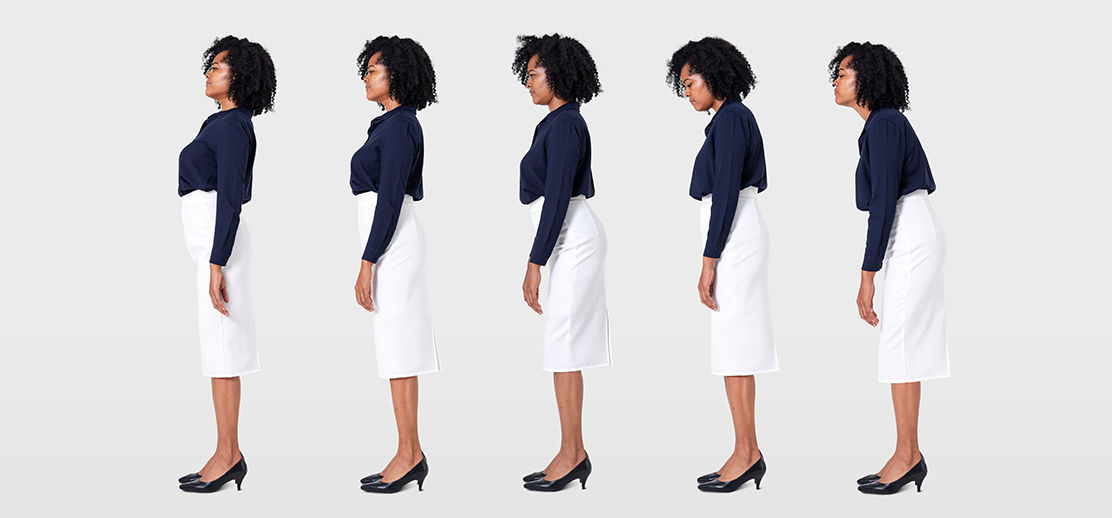
A position where a person holds the body upright against gravity in standing, sitting, or lying positions.
What is Poor Posture?
Poor posture results from tightening of certain muscles/muscle groups or shortening, whereas the contralateral (opposite/another side) muscles lengthen or weaken.
How to Check a Normal Posture?
Stand against the wall. Your feet, hips, upper back, and the back of the head should touch the wall. If these four points touch the wall, you have an ideal posture. If not, you might be having a poor posture.
Causes of Poor Posture
- Sedentary lifestyle
- Sitting at desk with ergonomically incorrect work station
- Core stability in bad shape
- Weakness and/or tightness of muscles
- No exercise or fitness regime
- Use of heavy backpacks
Types of Bad/Poor Posture
- • Lordosis -Exaggeration of the lumbar curve that aligns head behind the center of gravity. Shoulders pull back and shoulder muscles become tight.
- • Scoliosis-The sideways curvature of the spine, resulumbar listing in alignment defect in the spine, neck, shoulders, back, and pelvis.
- • Kyphosis- Also called forward head posture. The neck is pushed forward, and shoulders and upper back are rounded.
- • Flat Back - Lumbar curvature becomes flat. This creates an imbalance in the spine, and the person leans forward to compensate for this posture.
- • Sway Back - Hips sway forward, thorax/torso are swayed backward, and center of gravity falls behind the hips.
How to treat Poor Posture?
Treatment mainly focuses on strengthening the weak and lengthened muscles and stretching the shortened/tight muscles. Correction of a causative factor-like heavy backpack. Adaptation of active and healthy lifestyle.